


Direct Cremation in LA & OC: How Long It Takes
Families looking for a cremation service provider may wonder, “How long does direct cremation in Los Angeles or Orange County take?” This article covers timelines, permits, and how Opal Cremation ensures fast, affordable, reliable service.
Written by Troy Centazzo, Founder and CEO, Opal Cremation
With Contributions by Sam Reyes-Godbee, Yasi Dye, and Shannan Guillory from the Opal Team
Table of Contents
- Introduction
- What Is Direct Cremation?
- How Long Does Direct Cremation Take in California?
- What Are the Steps Involved in Direct Cremation?
- Additional Info: Timeline for Receiving the Death Certificate and Tips
- Opal’s Cremation Process in Southern California
- Frequently Asked Questions (FAQs)
- Additional Resources from Opal
- Helpful Downloadable Tools
Key Takeaways
- Direct cremation is the most straightforward and most affordable funeral option, with no embalming or formal services required. But how long does it take?
- In California, the full timeline for direct cremation is typically around two weeks, though delays are possible.
- Most of the waiting period is due to legal paperwork, approvals, and permits. The cremation itself only takes a few hours.
Introduction
Losing a loved one is heartbreaking. The last thing you need is uncertainty about what comes next. If you’re in Southern California – whether in Los Angeles, Orange County, or elsewhere – you may ask: how long does direct cremation take?
Understanding the timeline for a direct cremation in Los Angeles—a simple, affordable cremation without funeral services—can bring peace of mind.
It allows you to plan a memorial, coordinate family travel, and know when you’ll have your loved one’s cremated remains back home.
Need help now? Call us at 888-963-2299 or send us a message, and we’ll respond immediately.
What is Direct Cremation?
For families who have lost a loved one and are arranging their memorial services, direct cremation is a straightforward and affordable option. The lack of embalming, viewing, and formal funeral services simplifies the process.
Direct cremation is generally the most affordable funeral service option. Other common terms for direct cremation include:
- Simple cremation
- Basic cremation
- Low-cost or even cheap cremation
The Federal Trade Commission (FTC) Funeral Rule further simplifies direct cremation. It requires US funeral providers, including funeral homes and cremation service providers in California, to include a separate price for direct cremation on their general price lists (GPLs)
The 1984 regulation ensures transparency and allows consumers to compare services and costs without hidden fees or misleading bundles.
Direct cremation includes the following:
- Removal of the deceased
- Transportation to the crematory
- Basic service fee
- Necessary authorizations
- Cremation itself
What Cremation Doesn’t Involve
Direct cremation does not involve embalming, a wake/viewing, or a formal funeral service. One of the benefits is that it typically does not—or at least should not—take a long time. That way, a family can spend their time celebrating the life of their loved one in whatever personalized, celebratory way they wish.
However, some things may prolong the process.
Next, we’ll discuss the typical time the direct cremation process takes in Los Angeles and Orange County and factors that may increase or decrease the time.
Learn more: What is Direct Cremation?
How Long Does Direct Cremation Take in California?
In California, cremation involves a series of steps that are completed in order.
While the cremation only takes a few hours, other steps (like legal paperwork, filings, and approvals) mean the total timeline is typically around 1½ to 2 weeks. This spans from when you begin working with a service provider like Opal to the actual cremation services and return of the cremated remains, or ashes.
However, depending on the funeral home or cremation service provider you use, the cremation process can take up to 3 – 4 weeks to complete. Receiving the death certificate can take an additional week or more.
Below is an easy-to-follow timeline that estimates how long each step takes.
Quick Reference Timeline: The Cremation Process
|
Milestone |
Typical Timing |
What Can Delay It |
|
Pickup from a residence |
Within about 2 hours of your call |
– |
|
Pickup from a hospital, hospice facility, or coroner |
Usually within 24 hours; up to 48 hours during busy periods |
Release forms; coroner investigation or autopsy |
|
Doctor completes the medical section of the death certificate |
Within 15 hours of death, as required by law. (This is only the doctor’s part. Certified copies come later; see the last row.) |
Doctor availability |
|
Family signs authorization forms |
After pickup, usually the next day or later |
Reaching every family member who must sign |
|
Disposition permit issued |
About 48 hours after filing |
Missing or incomplete information on the death certificate |
|
Cremation |
2 to 3 hours, plus 1 to 2 hours to cool |
Crematory scheduling |
|
Ashes returned to the family |
Ready for pickup at least 24 hours after cremation. Shipping adds [X] days, depending on the method. |
Shipping method; weekends and holidays |
|
Total, from first call to ashes returned |
About 2 weeks |
Any of the delays above |
|
Certified death certificates |
3 to 10 days after ordering through VitalChek |
Coroner cases with pending test results can take months |

What Are the Steps Involved in Direct Cremation
Step 1 – Pick Up Your Loved One
Summary: Cremation service picks up the deceased
Timeframe: Within about 2 hours from a residence; usually within 24 hours from a hospital, hospice facility, or coroner.
When someone passes, a cremation provider is contacted to pick up the deceased from the location of death. This could be at a residence, hospital, skilled nursing facility, or other location.
The “decedent” (a legal term for a deceased person) may be located at a coroner’s facility due to an investigation into the cause(s) of death. In that case, your loved one will not be able to be picked up until the coroner’s office completes its examination, releases the body, and approves pickup.
If the deceased is to be picked up at a hospital facility, coroner’s office, or other medical facility, a release form is typically required. It must be signed by the next of kin before the cremation provider can pick up your loved one. Then, your loved one is taken to the crematory or your service provider’s facility.
 Why This Step Could Require Additional Time
Coroner / Medical Examination Investigation
California law instructs coroner and medical examiner departments to inquire into and determine the circumstances, manner, and cause of all sudden, unexpected, violent, or unusual deaths, and those deaths where the decedent has not been seen by a physician 20 days before death. Some investigations are simple and involve a few phone calls to verify the expected cause of death. Others require an extensive investigation.
Depending on the extent of the coroner’s investigation, a deceased loved one may be released within days. Examinations that require an autopsy or an extensive investigation will take longer.
If test results are outstanding, the coroner may release the body pending the outcome, which could take months to process. An investigator is assigned to each case and is responsible for providing the family with the status of the investigation.
Opal Insight
“Unless the deceased requires an autopsy or complex investigation, they are usually released in one or two days,”
— Sam Reyes-Godbee, Senior Care Manager at Opal (estimates are as of publication of this article).
Step 2 – Initial Upfront Disclosures
Summary: Providing the required documents
Timeframe: During initial consultation with service provider (immediate)
The cremation service provider must comply with the Funeral Rule and California regulations by providing various disclosures and documents to anyone inquiring about specific funeral services or hiring a service provider for cremation services. These are supplied or signed at the beginning of the cremation process.
They include:
| Document / Disclosure | Explanation |
| General Price List (GPL) and CA Consumer Guide to Funeral & Cemetery Purchases | The FTC and California law require funeral homes to provide a GPL to anyone who inquires about funeral services or prices California requires that funeral homes provide a consumer guide to anyone who inquires about services, and before drafting a contract for services |
| Disclosure of Preneed Funeral Agreement | Before drafting a contract, the funeral home must provide the purchaser a statement disclosing whether or not the California funeral establishment has any preneed agreement with the decedent for prearranged services |
| Authorization to Accept or Decline Embalming | The funeral home must secure an authorization from the person arranging the funeral services, stating whether they accept or decline embalming services |
Step 3 – Complete and File the Death Certificate
Summary: Completing the death certificate
Timeframe: Several days
Certifying the death certificate is a critical requirement of the direct cremation process. Death certificates are also extremely important for families because they are generally required whenever you close an account, access assets, file a life insurance claim, or settle a legal matter on the deceased’s behalf.
In California, the cremation service provider coordinates completion of the death certificate with the medical doctor and the decedent’s next of kin or agent, then provides the death certificate(s) to the family after certification.
Opal immediately contacts the physician who will complete the medical portion of the death certificate. We work with the doctor to complete the death certificate quickly. This could be the deceased person’s primary physician, a hospice doctor who provided care before death, or a medical officer from the coroner’s office.
Shannan Guillory from Opal explains that the medical information for the death certificate must be completed within 15 hours after the death, which in practice means 15 “business” hours. In our experience, we generally meet this timeframe. If a medical examiner’s office is investigating the cause of death, including an autopsy, it must complete the form within three days after examining the body.
The funeral director or another professional from your cremation service provider will collect the information required for the death certificate from the person responsible for arranging the cremation and funeral services.
Death Certificate Sample
Below is a screenshot of a portion of a certified California death certificate issued in Orange County. Information has been hidden for privacy reasons.

In addition to standard information about the person who passed away (address, date of birth, marital status), the funeral director will also request the following and other information to complete the death certificate:
- Social Security number
- Occupation
- Names of the person’s parents, including the mother’s maiden name, and their birth states
- Educational background
 Collecting information for a death certificate can take time. Opal’s vital information for prompts tells you everything you need to complete a death certificate in Los Angeles or Orange County. Simply fill it out and submit it to your cremation service provider.
Step 4 – Forms, Documentation, and Filings Required
Summary: The Funeral director assists the family in completing and signing forms
Timeframe: Usually the day after pickup or later
Several additional documents are required for the cremation process in California, and the authorized person(s) (usually the next of kin or designated agent) with the “right to control disposition” must sign them. The right to control disposition is a legal term to describe who can make decisions about funeral arrangements.
Opal helps families with all the forms and paperwork required for cremation services, making the process as streamlined and simple as possible. The table below lists the required documents.
| Document / Disclosure | Explanation |
| Cremation Authorization Form | Signed by the person with the legal right to control disposition, this form gives the provider permission to proceed with the cremation. It confirms the identity of the deceased, the family’s instructions for the cremated remains, and whether the deceased had a pacemaker or other implanted device. |
| Declaration for Disposition of Cremated Remains or Alkaline Hydrolysis |
Includes information about:
|
| Statement of Goods and Services | The contract for services with the service provider. This document outlines the items and services needed for cremation, like the urns and related goods. The service provider provides it to the purchaser. |
The graphic below shows portions of Opal Cremation’s Statement of Goods and Services, Cremation Authorization form, and the Declaration for Disposition form.

Why This Step Could Require Additional Time
Opal Cremation helps expedite this step by providing clear guidance and digital document signing, but the time required to complete the forms ultimately depends on how quickly the responsible individual(s) can provide authorization.
If your loved one left a specific person in charge (for example, in a durable power of attorney for healthcare, or the agent), this step can be completed quickly. Otherwise, the law may require multiple family members to agree, which can introduce delays.
For example, if the deceased has several adult children, a majority may need to sign. If there are five children, three must sign the forms. Electronic signatures make this requirement easier – people can sign from anywhere.
Opal has found that this dynamic can be challenging for family members who are coordinating cremation services if the children are difficult to reach or do not have a close relationship with the deceased or each other.
Step 5 – File for and Receive Permit for Cremation
Summary: Complete and submit the permit
Timeframe: 48 hours
California requires a “disposition” permit for each cremation. The word “disposition” refers to the final handling of human remains through cremation, burial, scattering, or other lawful methods.
The following are examples of disposition in California:
- Cremation and keeping the urn at home
- Burial in a cemetery
- Scattering ashes at sea
Local registrars in California, such as county health departments, issue disposition permits, generally as requested by a funeral director, as part of the cremation services they provide. The funeral home completes and applies for the permit as part of the death certificate certification process. Each death must be registered with the local registrar within eight calendar days.
Below is a screenshot of a permit for disposition, with the top and bottom halves of the form split for easier reading.
You’ll see that the permit must list the specific location of the cremated remains, and that any future changes require an updated permit. So, if a family decides to hold an ash scattering ceremony off the coast of Los Angeles several months later, they’ll need a new permit, which the funeral home can provide.

Why This Step Could Require Additional Time
Once the county health department receives an original death certificate and permit request—typically via the funeral home—they review the documentation. If the cause of death or required fields are incomplete, the application may be delayed until corrected.
The funeral home then coordinates a follow-up review by the original doctor who signed the filing. When the information is updated, the paperwork is resubmitted to the county health department for review. After a satisfactory review, the Los Angeles or Orange County health agencies will issue the cremation/burial permit.
“This situation (incomplete death certificates) doesn’t happen often, but requires us to start the process again. Depending on the doctor, it can take one to several days to complete. A coroner’s office may take longer [up to a week],” says Shannan Guillory from the Opal Care Team.
The graphic below summarizes the required filing and forms for direct cremation in Los Angeles and Orange County.

Opal Client Testimonial
“When I was suddenly faced with the realization my beloved husband would soon pass on, I quickly navigated through the maze of cremation services and saw Opal. Sam [from Opal’s Care Team] stepped in to guide me through final steps, explaining everything in detail. She alleviated my concerns so that I didn’t have to worry. She was caring, compassionate and thoughtful, which allowed me to grieve, knowing she was there if need be.”
— Janet C, Redondo Beach
Step 6 – The Cremation Process
Summary: Cremation process
Timeframe: 2- 3 hours, plus 1- 2 hours for cool-down period
Once all paperwork is in order and the mandatory legal waiting period (at least 24 hours after death) has passed, we schedule the cremation. The cremation takes place at a California-licensed crematory.

The actual cremation process – placing your loved one in the cremation chamber (sometimes called a retort) – typically takes about two to three hours.
The time can vary based on factors like the person’s body weight and the equipment’s temperature and efficiency. Before cremation, the crematory staff will gently prepare the body by removing any medical devices (such as pacemakers or prosthetics) for safety. Families are often relieved to know that this step is relatively quick.
Processing the Remains
The cremated remains (called “cremains”) must cool before being handled. Once cooled, the staff will process the remains, carefully grinding down any bone fragments to create a fine, consistent ash. This step usually takes another hour or two.
The ashes are then placed in a temporary container, a chosen urn, or keepsakes as the family selects.
Most funeral homes include a plastic temporary urn with their direct cremation package. Opal’s service package includes a handmade rosewood urn.

Step 7 – Delivering or Collecting the Ashes
Summary: Delivering the remains (ashes)
Timeframe: Depends on services provided by the cremation provider
Cremation service providers may deliver the ashes to you or a cemetery, or you can arrange to collect them in person. How long this takes can vary. Often, it’s a matter of scheduling a convenient time or allowing for shipping. If the family picks up the remains and urn at the funeral provider’s location, this could happen within a day or two of the cremation.
Many Southern California families receive their ashes within about a week after the cremation, but it can take up to 10 business days, especially if mail delivery or coordination with a third-party courier is involved.
The time it takes depends on the services the cremation provider offers.
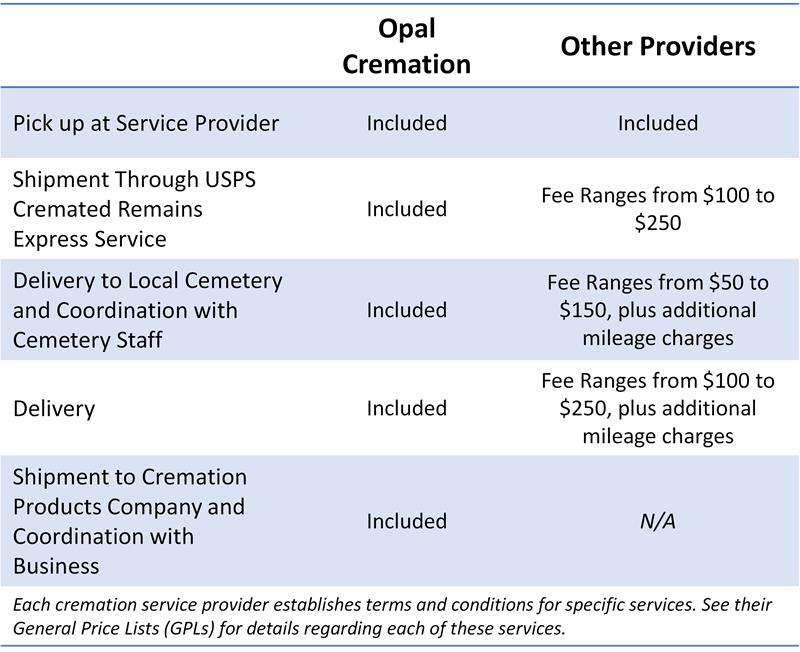
The table below includes a range of services offered by cremation service providers in Los Angeles and Orange County. Most providers only include “pick up” in their all-inclusive cremation services. Other convenient options for families—such as delivery or express shipping for cremated remains—generally cost extra, sometimes several hundred dollars.
At Opal, we include multiple options to return a loved one’s cremated remains – or ashes – in our cremation service package. The family can choose the option that’s most convenient for them.
Summing It Up
When you combine these steps, the cremation process—from the time of death to when you receive the ashes—typically takes about 2 weeks. Weekends and holidays can affect this timeline (government offices may be closed, and delivery services don’t ship on Sundays), so most providers quote the timeframe in business days.
While the actual cremation only lasts a few hours, paperwork and legal requirements account for most of the waiting period.
Additional Info: Timeline for Receiving the Death Certificate and Tips
Summary: Situations that may delay or speed up receiving death certificates
Timeframe: “It depends”
As explained, certified death certificates are very important to the deceased’s survivors. They are typically needed to access financial accounts, transfer property, settle estates, claim benefits, and update official records.
It’s safe to say that every single family we serve wants to receive the death certificate as soon as possible.
It generally takes 1-4 weeks to get a death certificate, depending on the cremation service provider. At Opal, we include an expediting service called VitalChek and UPS express shipping of death certificates as part of our cremation service package. This lets families receive death certificates within 3–10 days of ordering.
Why This Step Could Require Additional Time
The Funeral Home Uses the Traditional Process of Ordering Death Certificates
When we spoke to Mike Padilla, the Funeral Home Portal Manager for VitalChek, he estimated that about 25% of funeral homes in Southern California, including Los Angeles and Orange County, use VitalChek to obtain death certificates for their clients. This means 75% of funeral home clients may wait two months or more to receive them.
Most service providers in California still process death certificates for families in a traditional, largely manual process that involves ordering death certificates on behalf of their customers directly from the local or state health department.
This process is shown below.
| Step | Time |
| A paper application is submitted to the health department via mail or drop-off at the vital records office | 2 – 3 days |
| Processing time | 3 to 8 weeks |
| Death certificates get mailed to the funeral home | 5 to 7 days |
| The funeral home mails them to families, or a family representative must pick them up at the funeral home | 5 to 7 days |
| Total Time to Receive | Up to 10 weeks |
Source of information: VitalChek estimates
When evaluating a cremation service provider for your family, ask if they use VitalChek and express delivery to expedite death certificates. This service will allow you to receive death certificates within a week or so, compared to an average of two or more months.
Learn more: Quickly Get a Death Certificate Online in California with VitalChek Services
Download: Opal’s Cost of Cremation Worksheet (PDF)
Extended Coroner or Medical Examination
When a coroner or medical examiner’s office investigates a death, the outcome involves “determining the identity of the deceased, the medical cause of death, the manner of death, and the date and time of death.” A death certificate is issued within three days after the examination is completed.
Some investigations are straightforward and enable the pathologist to determine the cause of death quickly. Of the deaths investigated in Orange County in 2022, about 33% required autopsies. Other investigations require additional testing, such as a toxicology screen.
The Los Angeles County Medical Examiner notes that toxicology testing can take up to four to six months, which significantly delays the completion of the death certificate. In this case, the county will issue a deferred death certificate with a pending cause of death. Once the testing is completed, the coroner will amend the death certificate with the final cause(s) of death.
Families can use deferred death certificates with a pending cause of death for most purposes and later order the amended death certificate. However, life insurance companies may delay the policy’s payout if the terms depend on the cause of death.
Learn More: Who to Notify When Someone Dies | 2026 Opal Guide
Opal’s Efficient Process for Direct Cremation in Los Angeles and Orange County
A loved one’s death is a painful experience. Families would rather not deal with the uncertainty of cremation timelines. Ideally, they want to complete the process stress-free and focus on healing.
Opal allows loved ones to move on by offering efficient and affordable cremation services in Southern California. Our compassionate, caring team removes complexity and ensures a seamless process. We can handle arrangements, paperwork, and filing, and the actual cremation, returning your loved one’s remains in minimal time.

Our team is here to make a difficult time easier. We offer upfront, all-inclusive pricing, no hidden fees, experienced care professionals, and flexible memorial options. No wonder we’re California’s trusted source for simple, affordable cremation.
How Opal Can Help: Contact us to learn more or start arrangements today. Call us at 888-963-2299 or send us a message, and we’ll get back to you immediately.
Frequently Asked Questions (FAQs)
What factors influence cremation duration?
Several factors may influence the cremation timeline. For example, if families don’t have all the deceased’s relevant information, the death certificate delivery could be impacted. Shipping incidents and holidays can also affect the delivery of the death certificate and the ashes.
Working with a trusted provider like Opal can also expedite the process. We will ensure all forms are in place when needed and can even help with documentation. Our team will alert you when the ashes are ready and ship them as quickly as possible.
What causes delays in cremation timelines?
Typical delays in the cremation timeline include the time it takes to complete required paperwork and filings, as well as the service the funeral home provides to return the cremated remains (ashes) and urn to the family. Other causes of delay include whether the coroner’s office is conducting an investigation into the cause(s) of the death or if the county health department does not accept the medical information provided by the doctor who completed the death certificate.
What is the difference between a cremation and a direct cremation?
The main difference between cremation and direct cremation is timing. Direct cremation happens as soon as possible after your loved one passes, while other types of cremation may occur after a service.
How long does it take to get the death certificate?
If the cremation service provider uses VitalChek to expedite death certificate processing and express overnight delivery, families can receive certified death certificates within 3-10 days. Most funeral homes in Los Angeles and Orange County still use the “traditional” method of processing death certificates, which can take up to two months for families to receive death certificates.
Can I attend or witness the cremation?
Yes, most cremation providers will allow loved ones to view the cremation from viewing rooms or windows, providing a good way for families to say goodbye to their loved ones.
If a death happens at home, how soon will Opal respond?
If a death happens at home, we can transport the body within two hours. However, if the death was unexpected, we recommend calling 911 first.

Additional Resources from Opal Cremation
Funeral vs Memorial Services in Southern California | 2025
Who to Notify When Someone Dies | 2025 Opal Guide
Who to Notify When Someone Dies | 2025 Opal Guide (Spanish edition)


